Have you ever considered that sometimes Flying can be greener that driving?
We’ve all heard the environmental mantra: “Fly less, drive more.” And on the surface, it makes total sense. A colossal aircraft burning tons of jet fuel must be worse for the planet than a single car zipping along the highway, right? Well, not necessarily. The equation is far more complex, and a recent comparison on the Amsterdam to Milan route reveals a surprising truth.
It’s true that the raw fuel itself paints a dire picture. Jet fuel is generally more polluting than regular car petrol. Not only is it denser, releasing roughly 2.5 kg of CO₂ per litre compared to petrol’s 2.3 kg, but its emissions also enter the upper atmosphere. This is the crucial “altitude multiplier.” Scientists estimate that the non-CO₂ effects, like contrails and nitrogen oxides released at high altitudes, can amplify the warming impact by two to three times. It’s a significant factor that can’t be ignored.
However, focusing solely on the fuel type overlooks the critical element of scale and efficiency. This is where the unexpected twist emerges.
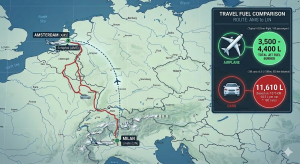
Consider a flight from Amsterdam to Milan, a distance of approximately 830 km. An Airbus A320neo, a workhorse of modern aviation, can carry around 180 passengers. For this journey, it would typically consume between 3,500 and 4,400 litres of jet fuel. While that sounds like a staggering amount, when divided by the number of passengers, the A320neo’s efficiency becomes remarkably clear: about 1.9 litres per 100 km per passenger.
Now, imagine if all 180 of those passengers decided to ditch the plane and drive to Milan individually in standard petrol cars. The impact would be significantly higher, creating a massive convoy.
An average petrol car carrying a single occupant uses roughly 6.0 litres per 100 km. Multiplying that by the number of passengers and the distance reveals a much larger collective fuel consumption and carbon footprint compared to the single plane carrying everyone.
The “efficiency plot twist” doesn’t stop there. Modern jet engines have seen incredible advancements in fuel efficiency. The leap from the older A320 “ceo” to the newer “neo” model represents a 15–20% improvement, largely thanks to innovative engine designs and cabin optimization like the Space-Flex concept. Airlines constantly refine these technologies to minimize fuel burn and operational costs.
In contrast, while car engines have undoubtedly become cleaner and more efficient over the decades, the pace of improvement has generally been more linear and less dramatic compared to the step-changes achieved in aviation propulsion.
So, while jet fuel is intrinsically more polluting, the A320neo’s ability to move large groups of people with exceptional per-passenger efficiency can, on a specific route like Amsterdam to Milan, result in a smaller per-capita environmental impact than if everyone chose to drive solo. It’s a compelling example of why nuanced comparisons and understanding the bigger picture are essential for making informed, sustainable travel choices.